The comfort zone is where dreams go to die

Saturday, November 11, 2023

Newton, the Crypto Exchange for Canadians

Entering the world of cryptocurrency can be an overwhelming yet thrilling endeavor, laden with opportunities and risks. As a Canadian enthusiast in this digital financial realm, finding the right platform for trading crypto has been a quest that has led me to explore numerous options. Among the many available exchanges, Newton has emerged as my primary go-to platform for engaging in the exciting realm of digital assets.

My decision to use Newton wasn't hasty. It stemmed from a thorough evaluation of various platforms' offerings, as well as a keen understanding of what I sought in a cryptocurrency exchange. As a now regular user of Newton, I've encountered a multitude of reasons why this Canadian-based exchange has become an instrumental tool in my crypto journey.

One of the primary reasons I gravitated towards Newton was its simple and user-friendly interface. Newton's platform simplifies the buying, selling, and transferring process, providing an intuitive and streamlined user experience without any unnecessary clutter. The clean design and accessibility of essential features have made the onboarding process a smooth and enjoyable experience for me. Its simplicity allows for quick and easy transactions, making it an appealing option for beginners and experienced traders alike.
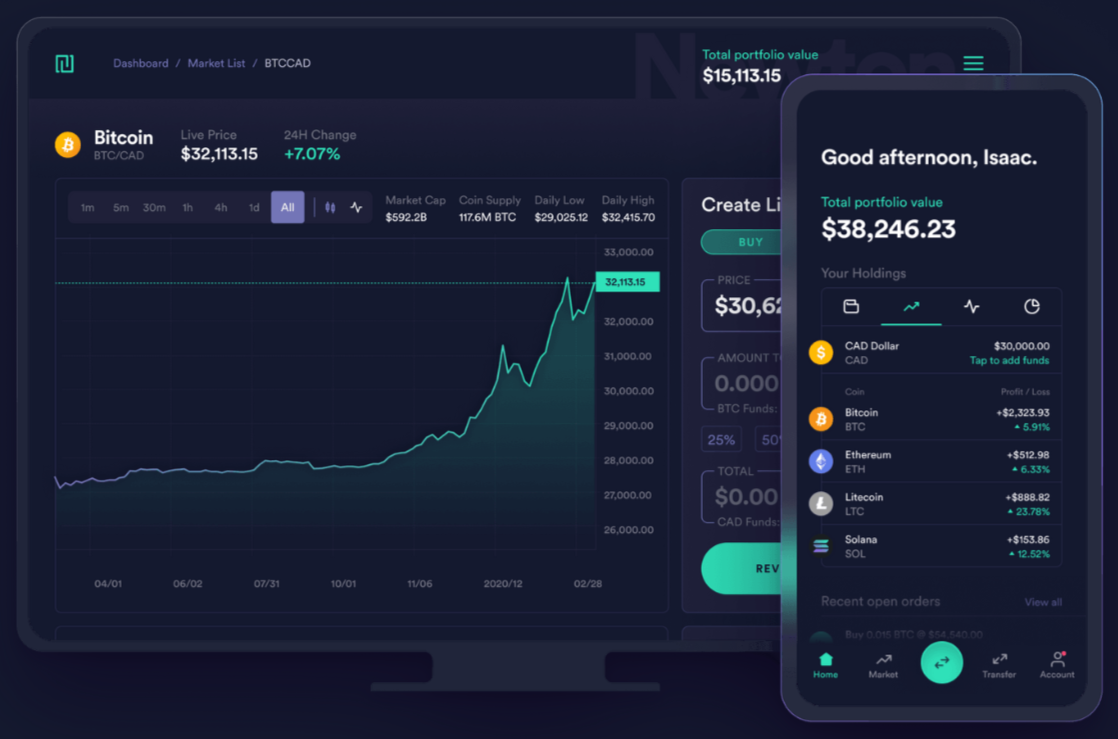
Newton User-Interface

Speed and reliability are essential in the fast-paced world of cryptocurrency trading, and Newton excels in these areas. Transactions are processed fairly, swiftly, and efficiently, eliminating potential delays that could affect trading outcomes. The platform's reliability, coupled with the seamless execution of transactions, has been instrumental in optimizing my trading experiences. It has afforded me the ability to capitalize on major market movements swiftly, a crucial aspect in the volatile realm of cryptocurrencies.

Security has always been a paramount concern when it comes to managing digital assets, and Newton takes this aspect seriously. The platform is built for crypto’s unique risks with security measures such as recurring penetration testing and cold storage for the majority of their assets; 80% of Newton’s assets are kept offline to limit their exposure to unforeseen issues and risks. This provides a sense of assurance and trust in the platform. However, it's worth noting that while the security measures are reassuring, Newton's status as a relatively new exchange in the market brings about an initial level of caution, despite the confidence instilled by these security protocols.

The variety of available digital assets for trading is another area where Newton has performed well. While it may not boast the most extensive selection of cryptocurrencies, it offers a diverse range, including prominent assets like Bitcoin, Ethereum, Solana, and others. This diversity provides ample opportunities for traders to explore and diversify their portfolios within the crypto ecosystem.

In my journey as a cryptocurrency enthusiast, Newton's 24/7 customer support has played a pivotal role in my overall experience. The responsiveness and helpfulness of the support team have been commendable, providing timely assistance whenever any questions or concerns arise.

Newton has been a welcoming entry point for many Canadians venturing into the crypto space, offering a secure and user-friendly platform. Despite its numerous merits, Newton, like any platform, is not without its drawbacks. In the following sections, I will delve deeper into both the advantages and limitations of Newton as an exchange, offering a comprehensive evaluation of its place in the Canadian crypto landscape. Additionally, I'll explore how a forex platform, Global Prime, may excel and be the preferred choice for specific trading needs.


Why I Use Newton to Buy and Sell Crypto

My journey into the world of cryptocurrencies led me to Newton, a Canadian-based exchange that has become my preferred platform for trading digital currencies. Newton's appeal stems from a combination of factors, most notably its user-friendly interface and the seamless trading experience it offers. Upon entering the realm of crypto trading, the sheer complexity of different platforms, digital assets, and market intricacies can be intimidating. Newton's user-friendly design and ease of use immediately stood out to me. In this ever-evolving landscape, the platform's simple layout is a breath of fresh air. It streamlines the process of buying, selling, and managing digital assets, providing an accessible gateway that is able to serve the needs of novices and veterans equally well.

Efficiency and Reliability of Transactions

The speed and reliability of transactions are pivotal aspects that contribute to a positive trading experience, and Newton excels in this domain. Transaction processing on the platform is rapid and dependable, eliminating potential lags or delays that might hinder effective trading. The platform's swift and efficient transaction execution has been crucial in seizing market opportunities promptly and responding to fast-paced market fluctuations, an integral part of successful cryptocurrency trading. Funding a Newton account via Interac e-Transfer from a connected Canadian bank account is quick and efficient. Withdrawing funds to a Canadian bank account is equally easy.

Commitment to Security

Security is a top priority when dealing with digital assets, and Newton addresses this concern by implementing several robust security measures. Consumer facing features such as mandatory two-factor authentication and corporate measures such as insured assets, institutional grade storage, as well as an in-house data security team add layers of protection to users' funds, instilling confidence in the platform's security protocols.

Access to the Most Relevant Digital Assets

While Newton might not offer the most extensive selection of cryptocurrencies, it boasts a diverse range of digital assets, including major players like Bitcoin, Ethereum, and Solana, among many others. This variety caters to different trader preferences, allowing for opportunities to explore and diversify portfolios within the Newton ecosystem.

Responsive Customer Support

In my experience, Newton's customer support team has been a valuable resource. Available around the clock, their responsiveness and assistance in resolving queries or issues have contributed to a smooth and reassuring trading experience.

My utilization of Newton for buying and selling cryptocurrencies has been underpinned by these standout features. It's important to recognize that while Newton exhibits multiple strengths, it has its limitations, which I'll explore in the subsequent sections to provide a holistic overview of the platform's performance in the Canadian crypto landscape.


Why Global Prime is Better for Day Trading Crypto

Newton, as a cryptocurrency exchange, undoubtedly possesses numerous advantages that make it an attractive platform for trading digital assets. However, when specifically considering day trading in the realm of cryptocurrencies, another platform, Global Prime, shines brighter due to its specialized tools and features tailored specifically for this purpose.

Newton's user-friendly interface, fast transaction processing, security measures, and available cryptocurrencies make it a robust choice for general cryptocurrency trading. It excels in providing an accessible and secure environment for investors to buy, sell, and hold digital assets. Nevertheless, when it comes to the specific demands of day trading, certain features of Global Prime offer distinct advantages.

Introduction to Global Prime

Global Prime, as a forex broker, is much better suited for day trading cryptocurrencies due to its experience, specialized tools, and tailored services. Day trading requires particularly swift execution, access to in-depth market analysis, and tools for technical analysis, all of which are distinct offerings of Global Prime, setting it apart from platforms designed primarily for standard crypto trading through buying and selling assets.
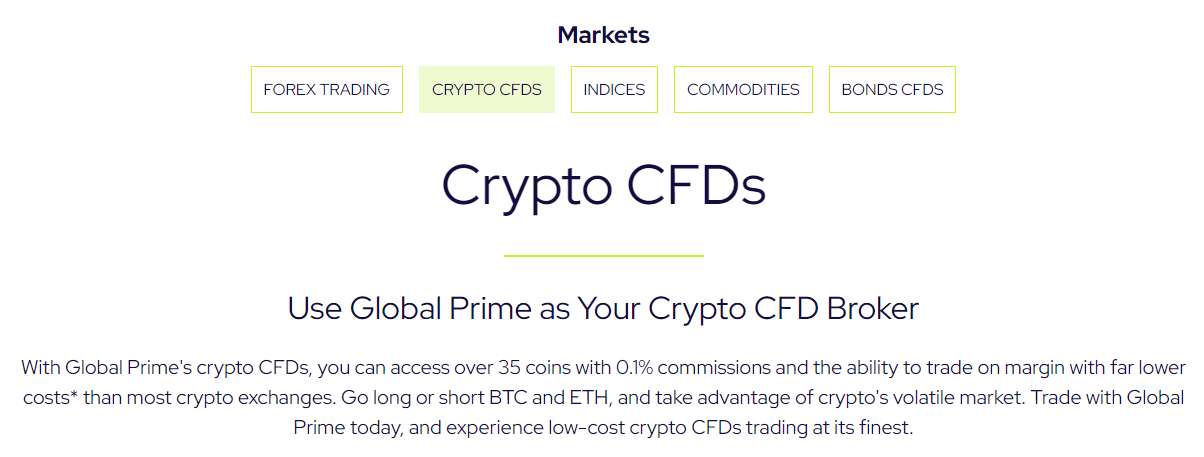


Global Prime's Tools and Advantages

Day trading requires rapid decision-making and execution, and Global Prime fulfills these needs efficiently. With features like access to professional-grade charting tools, robust analytics, and faster execution times, the broker significantly enhances the overall day trading experience, allowing traders to swiftly capitalize on short-term market movements.

While Newton is a fantastic platform for general cryptocurrency trading, Global Prime's specialized tools and focus on the day trading niche provide a more tailored and advantageous environment for those who seek to actively trade cryptocurrencies throughout the day. Additionally, Global Prime offers all the usual advantages of a world-class forex broker such as extremely low spreads, low trading fees, and - maybe most importantly - leveraged trading through the use of a margin account.

In conclusion, both Newton and Global Prime serve distinct purposes in the cryptocurrency trading landscape. While Newton excels in providing a user-friendly interface and a secure environment for general trading, Global Prime emerges as a superior choice for day traders due to its specialized tools, low fees, and the ability to trade on margin. Understanding your individual trading preferences and needs is crucial in choosing the platform that best suits your trading objectives.


A Note on the Drawbacks of Newton

While Newton stands as a commendable platform for Canadian crypto traders, it's essential to recognize that, like any service, it does have some drawbacks, although fairly minor in nature. In any case, acknowledging these limitations is crucial for a well-rounded assessment and understanding of the platform's performance.

Newton's Relative Newness in the Market

One noticeable drawback of Newton is its relative newness in the market. As a relatively new player in the exchange landscape, Newton might not possess the same level of reputation and trust that more established platforms enjoy. However, this drawback can be mitigated by primarily relying on the platform for trading purposes, but not as a wallet or storage solution for holding digital currencies for extended periods of time.

One of the key conclusions from the various scandals involving large crypto exchanges throughout the last few years is to never keep digital assets in a custodial wallet longer than necessary. One of the best ways to mitigate the risks associated with bankruptcies and/or corrupt individuals is to always transfer crypto assets to a non-custodial wallet as soon as possible. This helps ensure that you and only you are in full control of your assets.

Limited Selection of Cryptocurrencies

Another limitation of Newton is its somewhat restricted range of available digital assets. While it does offer the most prominent cryptocurrencies, some users might find the selection to be narrower compared to larger exchanges. To overcome this drawback, Canadian individuals seeking a more diverse portfolio can utilize Newton exclusively for exchanging cryptocurrencies to/from fiat currencies (i.e., Canadian Dollars), and then transfer those assets to a non-custodial wallet that offers swaps. This approach makes it possible to obtain and store a much broader array of cryptocurrencies than what is available for trading directly on Newton.

Operates Only in Canada

Newton's exclusive operation within Canada could be perceived as a drawback for users who wish to access the platform from other regions. While this restricts its accessibility on a global scale, for Canadian users, this focus on a local market can also be seen as a positive aspect. However, for those outside Canada, the limited accessibility remains a constraint.

Lack of External Security Audit

Although Newton implements several robust security measures, including internal security audits, it hasn't yet undergone an external security audit. This might be a concern for users who place significant emphasis on independent third-party security assessments.

As mentioned previously, one very effective way to address most of these drawbacks is to view Newton only as a gateway for buying and selling cryptocurrencies rather than a storage solution for holding them. Utilizing the platform primarily for trading purposes and swiftly transferring assets to a non-custodial wallet can offer a more secure and diversified solution for managing digital assets. To support this strategy, Newton covers the first $5 of the transaction fee on the first withdrawal to a 3rd-party wallet made in a fixed 24-hour period. On the first withdrawal of the period, only transactional fees above $5 will be a cost incurred by the user. By taking advantage of this, users can benefit from Newton's strengths in trading while mitigating the drawbacks associated with the platform's newness, limited selection, and potential security concerns.


Conclusion

In the quest to traverse the dynamic landscape of cryptocurrencies, Canadian traders often seek a cost-effective, reliable, user-friendly, and secure platform to kickstart their digital asset journey. Newton has emerged as a prominent option, offering an array of commendable features that cater to the needs of both novices and seasoned traders. Nevertheless, while it boasts numerous advantages, it's equally important to acknowledge the limitations and drawbacks that accompany this platform for a comprehensive assessment of its role in the Canadian crypto market.

Choosing the right platform for cryptocurrency trading is a deeply personal decision, dependent on individual needs, preferences, and risk tolerance. Newton serves as an excellent entry point for those stepping into the cryptosphere. Readers and potential users are encouraged to evaluate their specific trading objectives, weighing the strengths and weaknesses of different platforms. By considering personal needs and aligning them with the offerings of various exchanges, traders can make informed decisions that best suit their unique goals.


Disclaimer

There are substantial risks associated with trading and investing in securities or other financial instruments. Trading and investing in stocks, bonds, exchange traded funds, mutual funds, money market funds, and cryptocurrencies involves risk of loss. Loss of principal is possible. Some high risk investments or trading certain financial instruments may use leverage, which will accentuate gains & losses. Trading in foreign exchange ('Forex') on margin, as well as trading cryptocurrencies, entails particularly high risk and is not suitable for all people. Before you decide to trade or invest in foreign exchange, or any other financial market, you should carefully assess your objectives, experience, financial possibilities and willingness to take risks. Past performance is not an indication of future results!

Lastly, please note that the links to Newton on this page are affiliate links. If you use any of these links to register an account, you will get $25 CAD free if you make a trade over $100 CAD within 90 days of sign up. I only endorse Newton because of the positive experience I've personally had using the platform's products and services.
Share:

Tuesday, August 30, 2022

A Critical View on Proof-of-Stake; Why Bitcoin is Here to Stay

Consensus Mechanism

There are fundamental differences between ETH and BTC when it comes to their capabilities, intended use cases, and their respective ecosystems overall. I won't be discussing those in this post. I am merely using them as representatives for two radically different philosophies in the blockchain space, that of proof-of-stake and that of proof-of-work.

When we read about these things in mainstream news, on social media or any other space where these topics are being discussed, the primary consideration for one over the other is often cited as the environmental impact that they have - especially when it comes to power consumption.

There is no denying that a proof-of-stake blockchain has radically lower power requirements compared to a proof-of-work blockchain. Since the vast majority of power generated all over the world is currently not considered clean, sustainable energy, there is also no denying that at present a proof-of-stake blockchain will have a radically smaller energy footprint, and therefore much less of a negative environmental impact, than a proof-of-work blockchain.

However, in my opinion, while the above seems like a perfect argument to pivot towards proof-of-stake, it is also an extremely dangerous view that is both short-sighted and diverts attention away from a severe underlying issue with any proof-of-stake blockchain.


Mining ETH versus BTC

To understand the issue, first, let's take a small step back and look at why, especially recently, mining ETH has been more profitable than mining BTC.

The short answer is gas fees; they make up a significant amount of revenue for ETH miners but are largely insignificant for BTC miners. Ever since the NFT craze in late 2021 gas fees on ETH have skyrocketed and are often cited as one of the main issues of Ethereum when it comes to its viability in terms of mass adoption; you can read more about those scaling issues directly on the Ethereum website.

This video is a perfect landmark for when that NFT craze peaked in the mainstream.

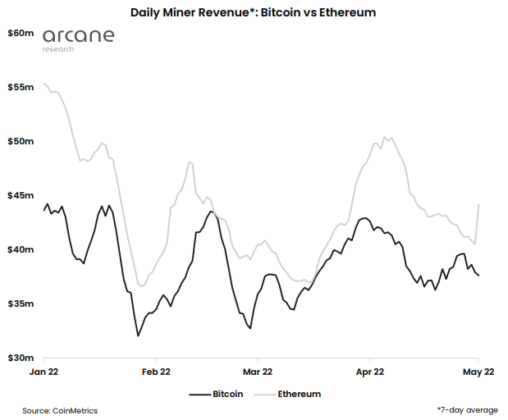
This is what mining revenues recently looked like when comparing ETH and BTC. Mining ETH is still more profitable than mining BTC, despite the initial NFT craze having largely subsided.

Daily Miner Revenue; ETH/BTC

The gas fees on Ethereum are still out of control and often make trading small amounts of ETH or low-value NFTs that live directly on the Ethereum blockchain prohibitively expensive, which in turn limits the overall potential and specific use cases of Ethereum. This is not a new or recent realization. In fact, to name two examples, it's the primary reason why Dapper Labs decided to build their own L1 blockchain Flow after their experience with Crypto Kitties on Ethereum - and the primary reason why L2 solutions and ZK-rollups like Immutable X exist.

Now add the negative environmental impacts, due to the escalating power demands of proof-of-work blockchains, on top of all of that and we have the perfect narrative for why proof-of-stake is supposedly the future of blockchain.


The Problem With Proof-of-Stake

In order to understand the issue, we first need to look at value creation, the foundation of every business and our capitalist society. The foundation of every business is to create and deliver value in an efficient enough manner so that it will generate a profit after cost. In the broadest terms possible, value is created through work. In scientific terms, entropy is reduced by investing energy, turning something that's chaotic and useless into something that is more useful to humans. In simple terms, you have to spend time and/or money in order to make money.

This is essentially the concept behind every proof-of-work blockchain, such as Bitcoin.

Institutional investing works very differently. Institutional investors are usually large market actors such as banks, mutual funds, pensions, and insurance companies that pool together funds on behalf of others and invest those funds in a variety of different financial instruments and asset classes. Those businesses do create value like any other - however, their investors don't, they just give them money to turn it into more money. The more money an investor will give to these institutions to invest into ETFs, mutual funds, crypto tokens, or similar assets, the more they will get in return. In other terms, the richer those investors already are, the richer they will get, without doing any work or spending any money.

This is essentially the concept behind every proof-of-stake blockchain, such as Ethereum will be.

One could say that there is nothing wrong with this, that's just how our society works, deal with it. I think that's a valid position to take, if being honest about it. However, the entire crypto scene has become a huge echo chamber about how blockchain, DAOs, decentralization, a free metaverse, and other buzzwords are going to be our salvation and the future of humankind; finally a way out of end-stage capitalism! The reality is that everything that is currently happening in the blockchain space is leading us into the exact opposite direction, the tokenization of everything, everything having some kind of precisely measurable monetary value associated with it, essentially capitalism on steroids. In the world of NFTs and blockchain, at least as it is being steered right now, you will be even less relevant than you already are if you're not already rich. If this future happens as it is being envisioned, it'll be the most extreme divide between the wealthy and the poor that has ever existed in the history of humankind. If put into the terms of a free-to-play video game, in the long run, all that's going to be left are the whales and the gold farmers.


Proof-of-Work is Not a Long-Term Issue

The current impact of the energy needs of proof-of-work blockchains is undeniable, even more so in these most recent times of international turmoil and war. However, I believe the right approach is not to get rid of proof-of-work as a concept, but to see this as an opportunity and argument to radically increase investments into clean and renewable energy sources.

Significant advances have already been made in the field of fusion energy. In a recent milestone at the LLNL, published this summer, researchers recorded a net-positive energy yield of more than 1.3 megajoules during only a few nanoseconds. For reference, that's enough clean energy to power a few thousand homes for a year. This is what we need to double down on.

Bitcoin and the proof-of-work concept were conceived with the Kardashev scale of civilization in mind, originally proposed by Soviet astronomer Nikolai Kardashev in 1964. Kardashev wondered about civilization, which he defines by its capacity to access energy, to maintain itself and to integrate information from its environment. I encourage you to read more about his ideas and how contemporary physicists expanded on it.

In this context, and by looking at those premises, it becomes clear how those ideas relate to a proof-of-work blockchain and Bitcoin specifically:

  • Access to energy; an ever increasing amount is required based on how proof-of-work creates an ever increasing complexity to solve. Over a period of time, this automatically accounts for radical breakthroughs in our ability to access energy.
  • Maintaining itself; the concept of decentralization, there is no single controlling entity or group of entities.
  • Integrating information from the environment; the concept of immutable information being publicly accumulated and stored on the blockchain.

All of the above is also one of the main reasons why Bitcoin has now become lot more like a naturally occurring commodity rather than something that's human-made and maintained, even though it factually is.

These are the same reasons why I believe that it's a huge mistake to switch Ethereum to a proof-of-stake blockchain. It's the antithesis to those concepts - access to energy becomes access to capital, maintaining itself becomes maintained through the people with the most money, because all crypto tokens have monetary value. Besides, there are already solutions that fix all the everyday issues this change is supposedly solving, namely L2 networks and ZK-rollups. It's basically an unnecessary band-aid for Ethereum to work around the energy issue, with potentially devastating results.

I do believe there is a perfectly valid and important place for more commercially oriented blockchain projects like BNB, FLOW, SOL, IMX, and way too many others to create an exhaustive list, especially when it comes to addressing the everyday practical needs of projects building on top of them, but nothing like those should be the foundation on which we build our digital future.

The right solution would be to fix the underlying issue, specifically the current energy scarcity, reliance on fossil fuels and other non-renewable energy sources that pollute our environment. That's a solution that would benefit all of humankind, all of us that are currently around as well as all future generations - not just the richest 1%.

I realize these are lofty, maybe even idealist thoughts. Then again, people should at least be honest about what their end-game is with proof-of-stake; it's about maintaining control and keeping our current societal order intact in the upcoming digital age, and a +1 at that.


Share:

Thursday, November 11, 2021

How Forex Brokers Make Money

100 Dollar

When I started to look at forex trading more seriously, one of the first things I had to do is to find a reliable and fair forex broker. I am very fortunate to have found Global Prime; they offer accounts for forex retail traders almost anywhere in the world, with only the exceptions of North Korea, Iran, USA, Puerto Rico, Ivory Coast, and Ontario, the province of Canada.

I already wrote a post about why I chose Global Prime as my forex broker. However, that is only a brief overview of the true depth beneath it all. The tip of the iceberg, in a sense. There is a very direct and straight forward honesty with which Global Prime operates and they genuinely value educating their clients about the business they are operating. To that end, they have an in-depth video series on their YouTube channel where they explain the ins-and-outs of the forex broker business from their own inside perspective. I found those videos to be highly educational, eye-opening even. I have not seen this type of candid discussion about the forex broker business anywhere else, especially not in this kind of detail.

The videos feature Angus Walker (General Manager), Jeremy Kinstlinger (Co-Founder) and host Sammy Althaus (Head of Retail Support) of Global Prime, alongside occasional guests. This is an overview of the first six episodes.

I found the first two episodes somewhat difficult to follow, I can imagine this is even more difficult for someone who is completely new to the topic. Somewhere after the third and into the fourth episode - following the discussion about dealing desks - was the point where it all came together for me and started to make sense. I hope the excerpts below are helpful for the purpose of following the overarching narrative. At the bottom of this page, you will find a broker quiz to help you understand what kind of forex broker you are dealing with and how honest they are with you.

Episodes

  1. A-Book vs B-Book
  2. Forex Brokers Profit From Client Losses
  3. Dealing Desks Exposed
  4. Real Liquidity vs B-Book
  5. The Real Reason Brokers Offer 500:1 Leverage
  6. Why Forex Brokers Profile Clients

Update; September 2023. Unfortunately, Global Prime decided to mark all the videos of this series private on YouTube. However, even though the videos aren't publicly available anymore, the core content is still preserved here on this page in the summaries below and provides an insightful overview on how forex brokers make money.


A-Book vs B-Book

The discussion in the first episode centers around the fundamental differences between A-Book versus B-Book brokers. This is a key indicator to differentiate between brokers who have your interests at heart versus those who are likely to do more harm than good to your trading account.

The difference, in a nutshell:

  • A-Book: Brokers who focus on connecting their clients to financial markets, helping them become profitable; they communicate transparently about all trades on a case-by-case basis.
  • B-Book: Brokers who provide a market to trade, but don't externalize trades and the risk; they simulate a market environment without actually connecting their clients to real financial markets.

Angus believes ~98% of current forex brokers use a B-Book model, and none of them focus on honesty and transparency with their clients. B-Book brokers focus on extracting losses from their clients, which leads to a lot of compromises in potential profitability for all of their clients. Interestingly, in 2018, a report of the Australian Securities and Investments Commission (ASIC) showed that trading clients lost ~$2 billion, while brokers profited ~$2 billion. B-Book brokers usually target inexperienced clients who don't fully understand the implications of trading in such an environment. The second episode goes more in-depth on this particular subject, explaining how exactly B-Book brokers are profiting from their clients.

Brokers, like any other business, need to focus on client outcomes (i.e. profitability) for long-term, sustainable success. Global Prime's goal is to do that for their clients in order to connect them to financial markets reliably, while educating them about the forex trading business to help them become successful as traders. This leads into an interesting and important discussion about the ethics of the forex broker business; I encourage you to watch the full episode to follow it.


Forex Brokers Profit From Client Losses

The majority of this episode further iterates on points about the ethics of brokerages and regulatory bodies that were introduced in the first episode, and how Global Prime operates differently than most other forex brokers.

Why do forex brokers B-Book?

Because most retail traders tend to lose, the profit margin for a B-Book broker is 2x to 6x greater than that of an A-Book broker. Brokers aren't penalized for the practice of directly profiting from their client's losses and can be vague about their product descriptions to create loopholes. They are also able to advertise leverage rates of 1:500 or higher, which helps them attract clients by making it appear as if they offer great trading conditions. In a sense they do, but leverage amplifies both wins and losses, and since most retail clients tend to lose it's in the best interest of B-Book brokers that their clients use as much leverage as irresponsibly as possible.

Usually, B-Book brokers profile and divide their clients into two groups - profitable traders are transferred to a secondary A-Book (connected to actual markets), while losing traders stay in the primary B-Book (markets simulated by the broker). The focus of these brokers is to optimize their B-Book trading to facilitate more clients losing, in order to maximize their profits. For profitable traders this usually creates very poor trading conditions, because optimizing liquidity for their A-Book is often an afterthought for these brokers.

B-Book brokers are similar to casinos and gambling business models in that they profit off of their client's net losses, not their net gains. They are focused on marketing and the constant acquisition of new clients instead of client retention and bringing actual value to their clients.

How does Global Prime compete as an A-Book brokerage?

Their product offerings are not that different from those of B-Book brokers, but the leverage offered to their clients is more conservative. A-Book brokerages focus on trade execution speeds, quality of trades, and typically have 1-3 prime brokers. A-Book brokers get direct liquidity from different banks and customize their pricing for institutional and retail clients.

A-Book brokers profit from a mark-up on spreads, swaps, and commissions - not off of a conflict of interest like B-Book brokers.

Essentially, this enables A-Book brokerages to focus on qualitative results for clients w.r.t. transparency, liquidity, and profitability instead of pure quantity of clients and trades. Global Prime specifically values building a community of educated and profitable traders who can hold the brokerage accountable for results and advice.


Dealing Desks Exposed

The third episode centers around dealing desks at a brokerage, what they are, how they operate, and why you should care about them.

Essentially, dealing desks are tasked with risk management for a brokerage.

The underlying principle, as with B-Book tactics in general, is for clients to lose, so that the brokerage can profit from those losses. In certain cases, dealing desks may even deploy deterrent strategies against winning clients to stop them from making too much of a profit at the brokerage's expense - such as artificial slippage, delaying trades, increasing latency, limiting execution speeds, or artificially changing the trading environment.

The checklist for a typical dealing desk:

  • In the long run, the clients always have to lose.
  • Hedge the least amount possible. The more exposed a B-Book broker is, the more money they stand to make. For instance, if they make $100-200 million in a quarter, then the market exposure they carry is, on average, over $1 billion.
  • Hedge less in volatile markets. More volatility = more client losses = more profit for the broker.
  • Clients with excess risk always blow up their account.
  • The A-Book is not the focus.
  • The core principle is always to optimize revenue per million and maximize profits for the brokerage through earning from client losses.

Dealing desks can switch a client from A-to-B-Book (or vice-versa) even mid-trade, and the client has no idea. This leads to the client suffering a higher possibility of losses due to the aforementioned unethical practices of delaying trades, artificial slippage, etc.

These forex brokers always have a set percentage of winning clients who are permanently put on the A-Book, but that A-Book itself is often only an afterthought, so the client doesn't have access to optimal liquidity or an ideal trading environment. This is bad for these profitable clients, as it is likely that they are getting a sub-standard return on their investment at the brokerage.

It can result in a double loss for the brokerage if they move a client from B-to-A-Book; i.e. if a client wins on the B-Book side, then the brokerage owes them money. Then, if that client is moved to the A-Book and loses, that's another loss for the brokerage as well because now the brokerage owes money to a bank. Thus, it requires good timing, expertise and substantial experience to operate a dealing desk at the highest efficiency.

B-Book brokers primarily make money from exposure + volatility = risk (the "formula" for client losses) not from commissions or spread revenue across clients. This is one of the reasons why they are eager to give 500:1 or more leverage to clients, who (statistically speaking) inevitably make large losses. Leverage amplifies both wins and losses, and the quicker clients blow up their account, the quicker a B-Book forex broker generates a profit.

What are the two most important tools for every B-Book brokerage?

  • Marketing. - This brings clients to the brokerage to make money off of them. Since the strategy is for clients to blow up their account, and it is expected of them to eventually give up forex trading in the process, these brokers require a constant stream of new clients.
  • Dealing Desks. - The broker completely controls the trading conditions and risk management policy by constantly monitoring and dynamically adapting the trading environment.

A-Book brokers on the other hand focus on managing liquidity and communicating with liquidity partners to make sure that their clients receive the best trade execution speeds and trading environment.

Why should you care?

The primary mission of dealing desks is making sure individual clients don't make too much money, so that the brokerage can profit from their losses instead. Being a high-value, high-volume, winning client is actually detrimental to a brokerage firm that primarily operates on a B-Book. This is why it's so important to know whether a brokerage has your best interests at heart - and to help answer that, please refer to the quiz at the bottom of this page. The Q&A style format should be self-explanatory after reading and digesting this article, even more if you watch all the videos as well.

Do A-Book forex brokers like Global Prime have dealing desks?

Normally, an A-Book forex broker does not have (nor need) a dealing desk.

However, batch hedging, where trades are internalized until they reach a certain value threshold, after which they are connected to the external market environment, has some characteristics of a dealing desk. The key difference is that these trades and clients are not individually profiled; instead, the trades are only internalized until their combined value aggregates over a preset limit. The brokerage doesn't make money off of any client's losses (if any) in this case. It is considered a budgeting and cost saving measure, in regards to transaction volumes, to accommodate retail traders with small accounts and to ensure profitable trades for all clients involved.


Real Liquidity vs B-Book

This discussion focuses on exhaust flows and the value of real liquidity of an A-Book brokerage vs that of a typical B-Book brokerage. The episode features Elan Bension (Co-Founder, Director Institutional) of Global Prime as a guest.

In the B-Book business model, when a broker moves a profitable client from their B-Book to their A-Book, they are "exhausting" the trade volume of that particular client into the real market. The losing clients are kept on their internal B-Book. Meanwhile, an A-Book broker tries to exhaust and showcase as much of their trading volume as possible to the market, to maintain complete transparency about all client transactions.

The system of trade in A-Book vs B-Book:

  • In general, the system of how the trades are executed in A-Book and B-Book brokerages are quite similar, up until the time when the counterparty fills the trade. With an A-Book brokerage you are trading against real, external liquidity providers, whereas with a B-Book brokerage the trade is being internalized by the brokerage.
  • In both cases, the trade goes through the platform and then hits a bridge/execution engine. Now, at the execution engine, in a B-Book execution, the trade will follow all the settings prescribed by the broker, i.e. the latency of execution. Then, the system will take a snapshot of the market liquidity after that latency time-gap has passed (e.g. 30 milliseconds), and then fill in the final order according to the available liquidity and other parameters present at that particular time.
  • An A-Book brokerage uses live-market trade response times; while B-Book brokers have to simulate/synthesize the latency, response times, and order fills for clients with larger orders. This isn't a true reflection of current market conditions and easily abused or manipulated for profit by the broker, at the expense of their clients.

The quality of liquidity = the quality of the relationship.

The quality of liquidity provided to clients is often dependent on the relationship between the brokerage firm and their liquidity providers. Global Prime has a team dedicated to communicating and showcasing the quality of their current client flow to their liquidity providers. Elan says that banks don't mind seeing diverse (both good and bad, i.e. losing and winning) client flow, because what matters most to banks is transparency. Due to this openness and dedicated relationship between the brokerage and their liquidity providers, Global Prime is able to provide a superior quality of liquidity to their clients compared to B-Book or even other A-Book brokerages.

In B-Book brokerages, there is usually a lack of transparency with banks. Those firms intentionally send them about 95% bad client flows (i.e. mostly the winning clients, which they don't want on their internal B-Book), which negatively impacts the banks investing with them. Thus, the banks start losing faith in the B-Book brokerage because they (the banks) are consistently losing money by investing with them. In the long run, this leads to the banks being more defensive with their injections of liquidity, which increases the risks of slippage and outages for the trading stream of the B-Book brokerage. This then affects both A-Book & B-Book clients of the firm, leading to system breakdowns.

Additionally, the A-Book clients of primarily B-Book brokers suffer from a lack of dedicated attention to their portfolios and liquidity management. Meanwhile, a purely A-Book brokerage can offer better liquidity and attention to their clients due to a better relationship with their banks. Having a good relationship with their liquidity providers also enables an A-Book brokerage to customize the revenue/liquidity streams to fit their clients better. For them their A-Book isn't an afterthought, it's the core of their business.


The Real Reason Brokers Offer 500:1 Leverage

There is a common sentiment in the forex retail trading community that one of the best ways to get higher returns is through higher leverage.

Is it possible to get higher returns (~5% per month) without very high leverage?

It is entirely possible to do so, but it isn't attractive to most traders because higher leverage seems like a good deal or shortcut to most. However, most of the traders who are entering the market today with B-Book brokers are uninformed about the true risks of higher (like 500:1 or more) leverage, and haven't had suitability tests done to actually assess their ideal leverage and risk capacity. Ultimately, this leads to the wrong belief that they absolutely require higher leverage to make more money, or even to make any significant amount of money at all.

However, B-Book brokers often have a near-guaranteed return on any investment they make with a losing trader. This is why they are happy to offer exorbitant leverage rates, or welcome and deposit bonuses, because at the end of the day the brokerage is going to make a net profit from their clients' losses, carefully managed by their dealing desk. Extremely high leverage is not always in every trader's best interest. Often, when traders ask back-office or B-Book brokers for higher leverage, there is no risk assessment done and minimal information is given to the trader about the risks involved. This usually leads to massively amplified losses on the trader's side, meaning quicker and higher profits for these brokerages.

Angus, Jeremy and Sammy all agree (as before, in the second episode) that B-Book brokerages are like casinos, where some people might get lucky every once in a while, but the house always wins. Angus reminds us that the general rule of thumb with trading is to try and make 1% profit with each trade, and nobody really needs 500:1 leverage to make a 1% profit.

Personally, I think the issue is that most retail traders misunderstand the purpose of leverage. They see it as a means to open a few extreme positions in an effort to make as much money on a few trades as quickly as possible. In reality, the main benefit of high leverage, as I see it, is that it allows you to open a lot of very reasonable positions in parallel. However, this is not something that a regular retail trader should be doing. If you're manually opening 20-30+ positions in parallel on a daily basis, chances are you're probably overtrading. For regular retail forex trading, something along the lines of 100:1 leverage is more than enough and already requires a fair amount of discipline to manage.

In equities trading and other financial trading platforms, there are usually stringent background checks and risk assessments required, no matter what kind of financial instruments are offered to traders, because there is an underlying market which is heavily regulated by proper institutions. In forex trading however this is not always the case, and there are many ways to skirt around the few regulations that are in place, which lead to the creation of the A-Book and B-Book business models in the first place.


Why Forex Brokers Profile Clients

Angus reiterates how B-Book brokers profile clients in order to optimize and maximize their own profits by carefully categorizing traders. As previously mentioned, the profit difference (revenue per million) between an A-Book and B-Book brokerage is significantly in favor of the B-Book brokerage. They don't have their clients' best interests at heart, since relieving them of the money in their account is their primary source of revenue, and will do whatever it takes to make money off of as many of their clients as possible.

The profiling of potential clients starts with the marketing team, who focus on jurisdictions where they predict a higher number of unsophisticated and amateur traders. The B-Book broker's primary objective is to get as many such traders on board as possible, because they are the main target of B-Book tactics. Usually, if a broker is offering a "learn as you trade" service, they are more likely to be running a B-Book. The same applies to welcome bonuses, deposit matching, and similar promotions.

In order to further profile their clients, a B-Book brokerage will then go through a client's transaction history and buying behavior. This serves to find out whether to categorize them as a losing trader (who is kept on their primary B-Book) or a winning trader (who is sent to their secondary A-Book), and which strategies to employ to make the most amount of money from that client.

Using highly sophisticated profiling strategies as well as experienced dealing desk operators, B-Book brokers are nearly always at an advantage. They can plan ahead and keep refining their methods of extracting profitability from losing traders by internalizing all of the risk and guiding inexperienced traders towards sustaining heavy losses. While the brokers have a plethora of information and data about their traders' skill level and trading history, the traders do not have this advantage/luxury, unless they use equally sophisticated third party tools.

At the end of the day, forex trading is a zero sum game and a B-Book brokerage will always be the winner in the trading environment they provide and fully control. It is a very adversarial and competitive situation, with a major conflict of interest between the B-Book brokerage and their clients. Winning clients who are making money are essentially a kind of opportunity cost for B-Book brokers, or in other words, a necessary inconvenience that comes with the territory. - Isn't that precisely the reason we all started forex trading though, to win trades and to make money?


Broker Quiz

The following five questions can be asked of your favorite broker.
If your broker is honest, they should be able to answer you easily and without hesitation.

      • Rule #1: This must be sent to the compliance department of your broker.
      • Rule #2: You must demand YES/NO answers for this to be effective.
  1. Do you profile your clients into separate books (i.e. A-Book / B-Book) based on their profitability? YES/NO?
    • The answer should be NO. An ethical broker should not offer different trading conditions to their clients based on their profitability.
  2. Can you categorically state that you do not profit from client losses through warehousing client trades? YES/NO?
    • The answer should be YES. If the answer is NO, then the broker is primarily set up to profit from client losses instead of providing access to financial markets as a service.
  3. Do you notify clients when you switch them from A-Book to B-Book ? YES/NO?
    • If the answer to the first question is YES, then the answer to this should be YES as well. That would mean the broker is profiling clients, but at least honest about doing so. If the answer to the first question is NO, then the answer to this question should be N/A.
  4. Can your clients increase their leverage without any assessment? YES/NO?
    • The answer should be NO. A responsible broker will make sure that clients do not overtrade and understand the risks of trading with very high leverage.
  5. Do you provide some form of post trade transparency to demonstrate which liquidity provider filled the client's trade? YES/NO?
    • The answer should be YES. Otherwise there is no transparency on who filled the trade on the opposing side and whether the trade was based on real market conditions.

Share:

Sunday, January 17, 2021

Forex Trading Journal - Calendar Week 1/2, 2021

After taking a bit of a break, and reading some related books on trading financial markets, I am back in the forex trading world. I have now completed a mentorship course offered by my broker Global Prime. This course is currently available for free to all active traders of their brokerage; i.e. traders with a live account who deposited at least the equivalent of A$ 200. There are is a also an entirely free preview for the course, which only requires a demo account with Global Prime, and gives an introduction to the types of strategies that are being taught.

Additionally, there are Discord chat rooms that allow traders who are practicing a certain type of trading strategy to communicate with each other and with their mentor, ask questions, analyze each other's trades, and so forth.

I am still using TradingView to search for setups, then execute those trades in MT4. For this purpose, I have found my multi-monitor setup with my PC and laptop extremely helpful! This is what my dashboard and chart setups look like now, for the specific strategy that I am practicing with:

TradingView Chart Setup

All of the indicators and the strategy behind them are explained in detail in the course material that can be found on the Global Prime website.

I have executed 3 live trades based on this strategy; all 3 of them failed due to human error on my part.

MyFXBook Overview

Trade 1

AUDCAD long.

AUDCAD long.

The setup for this trade was valid, going well for a while, and went up easily to 100% profit. At this point, according to the strategy, I should have moved my stop loss to break even, which I didn't do. I was motivated by greed and the expectation to chase an extra few pips. Excited that this trade was going well, I did not want it to get stopped out. Like one of the mentors at Global Prime said to me: "Never chase those extra 3 pips, there is always another bus to get on." I didn't have the discipline of sticking to my strategy, which is required to be successful as a trader. I also held the position over the weekend, in the hopes of the trade going my direction again in the new week. The result was a loss instead of breaking even.

Trade 2

EURCAD short.

EURCAD short.

This was simply a weak setup, wishful thinking on my part, trying to find patterns when there were none. The result was that the trade went straight against me and resulted in a loss.

Trade 3

AUDJPY long.

AUDJPY long.

Same as the trade before, this was a weak setup, wishful thinking on my part, trying to find patterns when there were none. The result was that the trade went straight against me and resulted in another loss.


Share:

Sunday, December 6, 2020

Forex Trading Journal - Calendar Week 48/49, 2020

The last two weeks have been less about trading and more about learning and continually realizing how little I actually know. I also used the opportunity that came with Black Friday discounts to purchase some upgrades for my computer setup.

In terms of a trading strategy, one of the things I noticed is that most of the free Forex courses that are available on the internet will teach the theory behind technical indicators, talk about fundamentals, risk management, and so forth. They're basically handing you over a tool box, briefly explain how the tools work, but then you're on your own to figure things out from there. I believe what then happens for the majority of people - and that's exactly what I was doing - is that they take a chart, slap on a couple of technical indicators they like but which are more or less unrelated to each other, call that their strategy, and then enter trades based on whatever they believe those random indicators are telling them.

Then the majority of people tend to lose the majority of trades and blow up their accounts.

It's a bit of mystery why that's happening, because they're doing exactly what they're supposed to do according to whatever technical indicators they're using. It's almost like a conspiracy and as soon as they enter a trade, the market always does the opposite of what it was supposed to do!

Again, that's exactly what was happening to me in my first few weeks of live trading.

I didn't really understand why this is so common until I saw how professional, profitable traders work and what kind of strategies they are using. Then suddenly it all became clear to me. If I wanted to summarize it in a few sentences, I would say that in order to develop a strategy that provides an actual edge, you need to layer indicators on top of each other in a meaningful way, so they complement each other. Most technical indicators have their strength and weaknesses. In order to mitigate the weakness of a certain indicator or an entire strategy, you need to identify which other indicator(s) can help with that. It's even likely that some indicators need to be applied and checked on higher or lower timeframes than the one you're intending to trade in. I've seen different approaches from professional traders, in both directions, confirming setups on lower timeframes (e.g. 15min or 1h) and managing trades on higher timeframes (e.g. 4h or daily), and vice versa.

As I mentioned in previous blog entries, I believe it's possible to self-educate oneself about all of this and eventually develop a proper strategy. However, that will require a significant amount of time and money. Also, I thought to myself that just because it's possible doesn't guarantee that I'll get there eventually. So I decided to look into one of the mentorship programs that my broker Global Prime recently started offering. Those mentorship programs are currently free for active traders who have a live account with them, although that might change in the future. I am now learning a strategy which looks for setups on the 1h/4h charts, then takes and manages trades on the 15min chart. It's a fair amount of material to go through and internalize. I should be in a position to start experimenting with actual trades in the coming weeks.

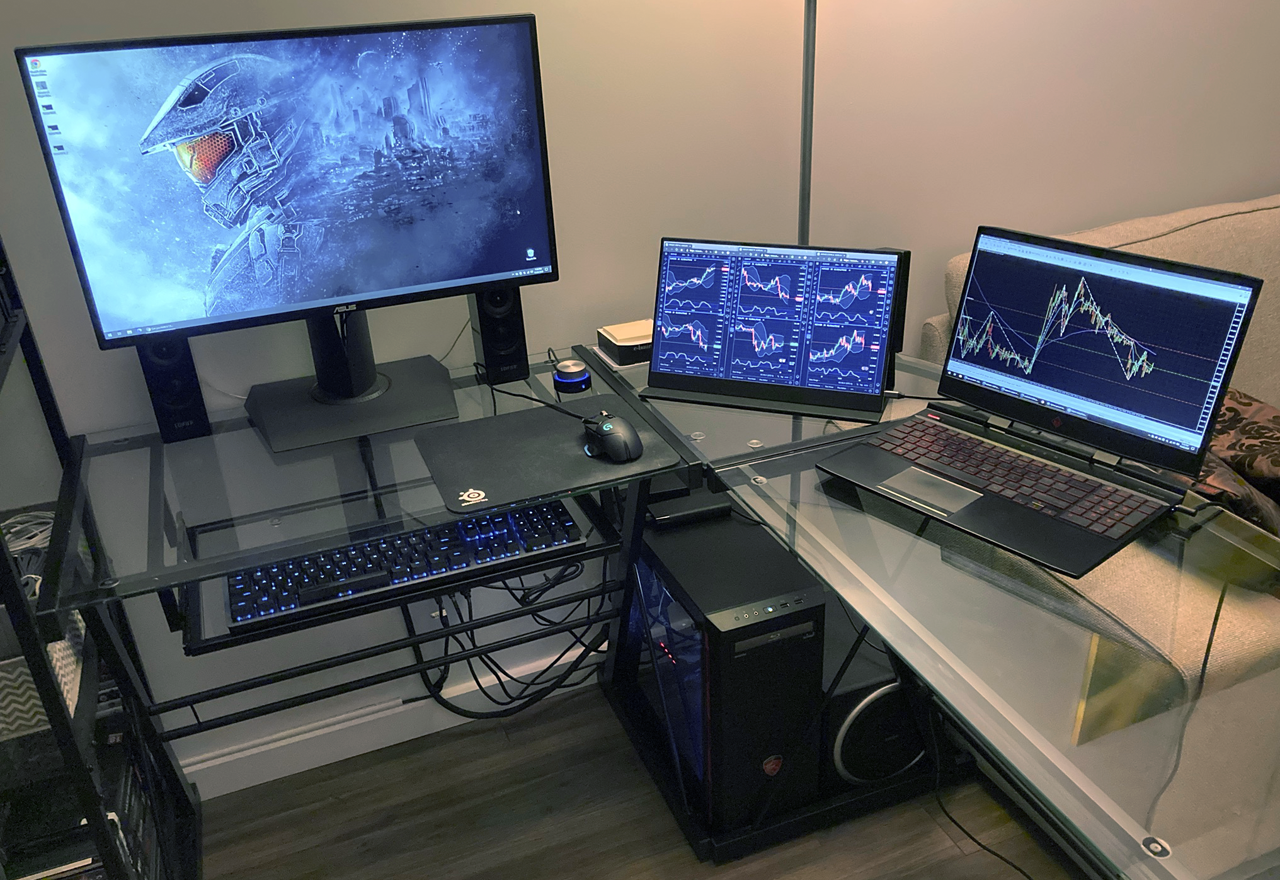
As for my PC setup, I decided to purchase an external monitor for my laptop and use that for now. This gives me 3 screens on 2 computers in total and I can take this external monitor with me when travelling. I went with a brand called 'GICHAT', which I had never heard of before, for the portable monitor. It turned out to be an extremely positive surprise, the quality of the monitor exceeded all my expectations! The built-in monitor of my HP laptop is already excellent, the visual quality of this portable one is even better.

I also purchased a new Logitech keyboard while I was putting in the Amazon order for the monitor. I'm very happy with that as well. It looks stylish, has several cool lighting effects that can be fully customized, and typing on it is very comfortable.

This is what my trading desk & office looks like:

Trading Desk

I still want to purchase 2 full-size monitors and a monitor mount to use with my desktop PC, but this should do for now.


Share:

Sunday, November 22, 2020

Forex Trading Journal - Calendar Week 47, 2020

This week is not going to be a typical trading journal post, but more of a progress update.

After figuring out the basics and getting everything set-up and in place, experimenting with some live trading, I decided to take a step back and ask myself the question: "What do I really need in order to become successful as a trader?" Interestingly enough, this started by me getting invited to a webinar about journaling trades and how that can help improve my trading. The webinar was average, not really anything I wasn't aware of yet, but someone blurted out a book recommendation that caught my attention. I looked into that, among some other things I was evaluating this week, and eventually realized it all boils down to 3 key components that are essential for success:

  • A profitable strategy.
  • The right mindset.
  • The right environment.

In fact, this might apply to many aspects of life, but right now I am looking at this specifically from a trading perspective.

A Profitable Strategy

There are many approaches to gaining an edge in the market. One thing I know for sure by now is that it's incredibly difficult to start from scratch, going in blindly, and to figure everything out by myself. I believe it's possible, but either way, I'm fully convinced that this would require a substantial amount of time and a fairly large monetary investment.

There are strategies that are being peddled on the internet, which is not something I am interesting in or have looked into.

Fortunately, my broker Global Prime recently established a new Discord server, where highly skilled, experienced and very successful traders offer to mentor other clients of Global Prime, entirely for free. They share their strategy and knowledge, it's possible to ask questions and get feedback, and there are regular calls where the mentors talk about their strategy, how they implement it, what works for them and what doesn't.

This doesn't mean that it's as simple as copy and paste, but it's so much more of a head start compared to starting completely from scratch all by myself. Although I am fully aware that eventually I will still have to figure out what works for me personally, how to adapt any strategy to my own trading style and then work with that.

If you are reading this for whatever reason, know one thing, and I cannot stress this enough: TRADING IS A SERIOUS JOB AND A FULL-TIME CAREER, NOT A GET RICH QUICK SCHEME. Some people try and take shortcuts, go into chatrooms to receive trading signals, or they copy trade, and so forth. I believe this is part of the reason why the vast majority of people ultimately fail and tend to incur losses. You have to treat this as a serious job, like any other, and accept that it will take time to master it. In my previous career, it took me around a decade of very hard work to get to a point where I achieved mastery and things became essentially effortless.

I just started digging in, this is work in progress.

The Right Mindset

The following part will be quote heavy.

One of my core believes is that if you're really serious about something and are investing your time, money and effort into it, are persistent and won't let yourself get dragged down by misfortune, setbacks, other people or difficult circumstances - then the universe will come to your aid and the things that you really need to become successful will somehow present themselves to you.

That's essentially how I came across an interesting book:

"Trading in the Zone is an in-depth look at the challenges that we face when we take up the challenge of trading. To the novice, the only challenge appears to be to find a way to make money. Once the novice learns that tips, brokers' advice, and other ways to justify buying or selling do not work consistently, he discovers that he either needs to develop a reliable trading strategy or purchase one. After that, trading should be easy, right? All you have to do is follow the rules, and the money will fall into your lap.

At this point, if not before, novices discover that trading can turn into one of the most frustrating experiences they will ever face.

This experience leads to the oft-stated statistic that 95 percent of futures traders lose all of their money within the first year of trading. Stock traders generally experience the same results, which is why pundits always point to the fact that most stock traders fail to outperform a simple buy and hold investment scenario.

So, why do people, the majority of whom are extremely successful in other occupations, fail so miserably as traders? Are successful traders born and not made? Mark Douglas says no. What's necessary, he says, is that the individual acquire the trader's mindset. It sounds easy, but the fact is, this mindset is very foreign when compared with the way our life experiences teach us to think about the world."

This is from the foreword, and it peaked my curiosity. At this point I am about halfway through the book and I can honestly say that it's more than just a technique, or a method you robotically apply, or something else along those lines. It's about more than that. I am now starting to understand how in order to master trading, and to have a chance of becoming one of the few successful people in the field, I first have to master myself.

Also, on a more personal note, this quote from the book really resonated with me, for various reasons...:

"I started trading in 1978. At the time, I was managing a commercial casualty insurance agency in the suburbs of Detroit, Michigan. I had a very successful career and thought I could easily transfer that success into trading. Unfortunately, I found that was not the case.

By 1981, I was thoroughly disgusted with my inability to trade effectively while holding another job, so I moved to Chicago and got a job as a broker with Merrill Lynch at the Chicago Board of Trade. How did I do? Well, within nine months of moving to Chicago, I had lost nearly everything I owned. My losses were the result of both my trading activities and my exorbitant life style, which demanded that I make a lot of money as a trader. From these early experiences as a trader, I learned an enormous amount about myself, and about the role of psychology in trading."

The Right Environment

I have written about some of this before, when I explained why I chose Global Prime as my forex broker. However, there is more to it than that. It's also about the people you surround yourself with, the company you keep, your co-workers and business partners, and especially the friends you have - in other words, your social circle.

There is another interesting quote I came across this week, from a life coach called Corey Wayne:

"Life and living at your personal best is to be found living in the present moment taking action towards becoming all that you are capable of being. The action you take or fail to take today is what will determine what your future becomes. Winners expect to win and take the actions required to eventually manifest their grandest goals and dreams, despite the fact that success lies far off in the future or seems unrealistic to others.

Losers quit and give up on their dreams when the first sign of difficulty or challenges arise, and then they seek to sabotage the dreams of those around them so they can convince them to give up like they have, so they can feel better about their lack of success. Misery loves company.

Your inner circle ideally should consist of people who are just as committed to their own greatness as you are to your own and who celebrate and encourage your victories and continued perseverance."

There are many formulations of this principle, a fairly popular one for the negative side of it is crab mentality:

Crab Mentality

In short, choose your friends wisely and get out of that bucket!


Share:

Sunday, November 15, 2020

Forex Trading Journal - Calendar Week 46, 2020

This was my worst week yet, in terms of winners/losers - I lost all of my trades, 100%. I only took 5 trades the whole week, 3 on Monday, 2 on Thursday. While things were still somewhat erratic and unpredictable due to the continued uncertainty of the US presidential election spilling over from the previous week, that wasn't really the reason for my results.

Results - Week 46, 2020

I wasn't necessarily just plain wrong on what I thought would happen, compared to what did actually happen. Sometimes of course I was just plain wrong. However, what often tends to make me lose is the timing of entering my trades. I will observe, wait and analyze to gain confidence. By the time I decide to enter the trade, I might have assessed the current situation correctly but the market has already moved on.

Here is a good example, the first trade of the week, going short on USDCHF.

First, looking at Bollinger Bands on the 30 minute chart, USDCHF was getting to a place where it appeared heavily overbought.

Bollinger Bands

My thoughts at this point were that there was either going to be a short retracement, or potentially a trend reversal. Either way, it seemed like a good opportunity to go short. Looking at some trend lines on the 1 minute chart seemed to confirm this.

Trend Lines

It did indeed turn out to be a short retracement. Sadly - and, of course - by the time I had built enough confidence to actually enter the trade, the retracement was just about ending and the overall uptrend of the USD continued.

This isn't the first time something like this happened.

Now I am thinking that maybe I should experiment with trades on longer time frames, with different lot sizes and different ranges for my stop loss and take profit targets. This week, I have also learned that my broker Global Prime has a Discord server with mentor rooms to help new traders like myself. While I have a tendency and preference to figure things out by myself, that is something I might explore in the coming weeks.

On a more technical side of things, there were some good news though! I was made aware that Global Prime is now integrated with TradingView.

Global Prime on TradingView

This is excellent, since it allows me to use the same data source for my trading as well as my charting. Global Prime even has plans for the future to enable trading directly through TradingView, which would make entering trades while charting super convenient.


Share:

Wednesday, November 11, 2020

Why I chose Global Prime as my Forex Broker

Choosing a reliable forex broker is not easy. It feels like there is an endless list of brokers available online, and many seem to be much of the same. Most brokers offer the same currency pairs, trading platforms, funding methods, commissions, spreads and so on.

Before starting my journey into the world of live forex trading in earnest, I spent several months looking into and trying several brokers. I was always underwhelmed and often disappointed one way or another. After opening trading accounts with numerous brokers, I finally discovered Global Prime. Knowing how difficult it was to find a broker that matched my expectations, I feel it is important to share my experience and hopefully help other aspiring or established traders like you. Here are the reasons why I use Global Prime as my forex broker.

Recently, Global Prime started adding crypto CFDs to their portfolio, allowing traders to access a growing selection of coins (already over 35) with 0.1% commissions and the ability to trade on margin with far lower costs than most crypto exchanges. This allows crypto traders to tap into the vast experience of Global Prime as a forex broker and to benefit from their professional tools as well as all the other positive features outlined on this page, especially when it comes to reliability and security of assets.


Why Global Prime stood out to me?

The way forex brokers position and brand themselves is very uniform and feels a lot like being in an echo chamber. Frankly, I don’t care which football team my broker supports, what kind of news and narrative they are pushing, or whatever else they have going on. I want consistently favorable and reliable trading conditions that will allow me to prosper and profit.

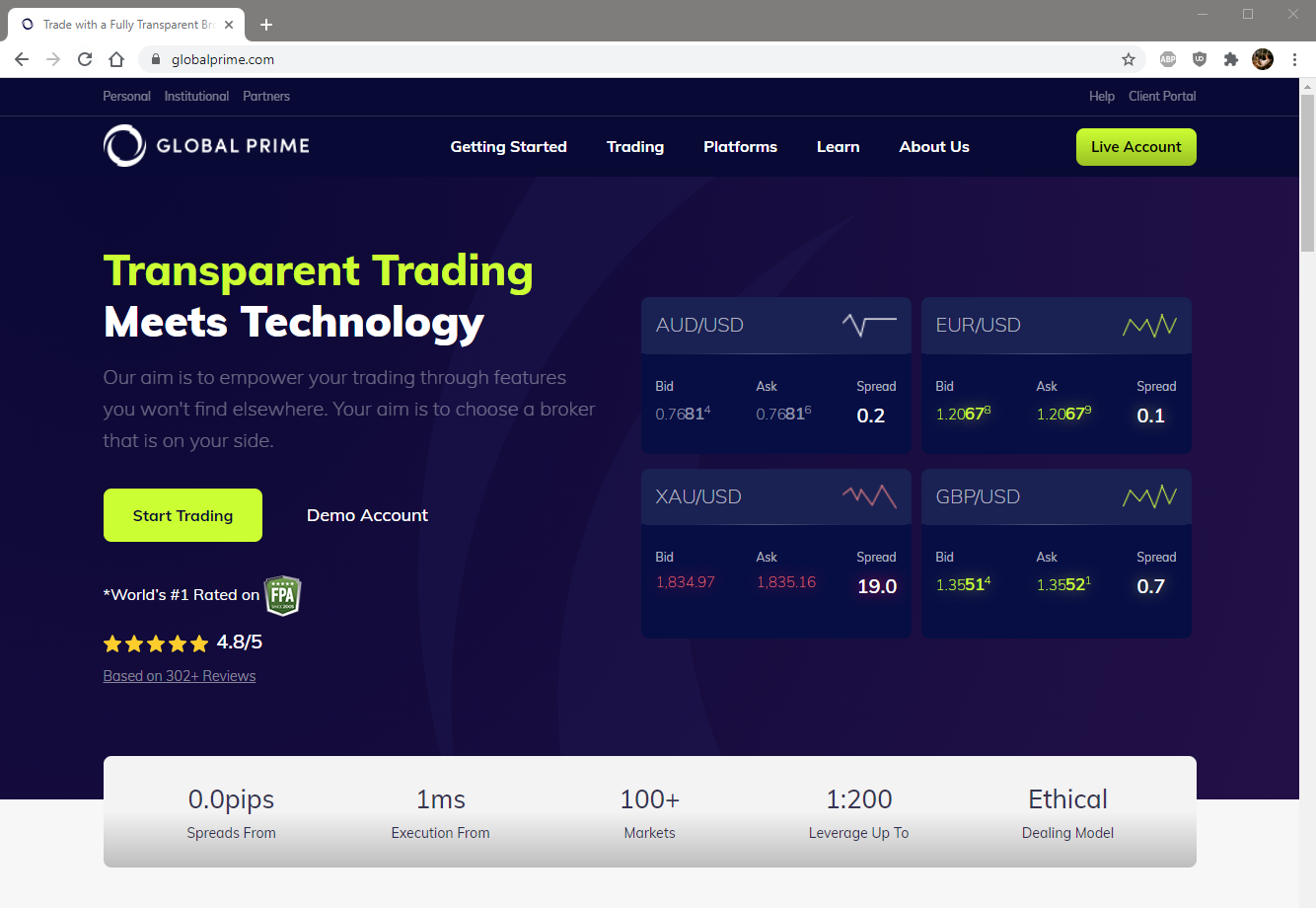
Global Prime Website

The first thing that stood out to me was the design and language on the company’s website: https://globalprime.com - This broker has a minimalist, professional and institutional tone that I connected with. It grabbed my attention because the site doesn’t just throw out jargon and buzzwords like ‘ECN’ or ‘STP’; they go into specifics and clearly explain the business model behind the company. I haven’t seen this approach taken before.


What Makes Global Prime a Real ECN Broker

Global Prime offers one trading account for all clients. It’s an ECN account, but it genuinely is an ECN account. Many brokers mislead traders into believing they offer ECN trading. In reality, they offer ECN pricing, which means quotes are derived from an ECN but not executed that way. Or they offer so-called ECN accounts, which is normally used to describe a low spread account rather than an execution method.

The Global Prime business model is simple; provide the best possible quotes and be remunerated a fixed commission for every trade processed. They do not profit from client losses, which means there is no conflict of interest between me being profitable as a trader and them being profitable as a business. They want me to be successful.

You might wonder how you could ever know if a broker is really ECN or not. Global Prime figured it out; they are the first broker to offer trade receipts which will verify the counterparty (usually a major bank or similar type of liquidity provider) that took the other side of your trade. In addition to showing you which liquidity provider filled your trade, trade receipts will show other essential information, such as spread, market profile, execution time, slippage and more.

There are many benefits to receiving trade receipts from your broker, and it goes further than fairness, honesty and showing that your broker doesn't profit from your losses. You can use this information to understand how the market behaves and understand how orders are executed in a wider context, on a global scale.


Why Execution is Important

There are different business models that forex brokers operate; they are broadly categorized as A-book and B-book. The vast majority of brokers use a B-book execution model, which means your trades are executed inside a black box that traders do not have visibility into. With a B-book broker, you have no idea how your trade is filled; the broker could match it against another client, hedge externally or - what typically happens - your broker could be the counterparty profiting if and when you lose.

An A-book broker uses a straight-through-processing (STP) technique to execute orders with external counterparties. Many traders mistakenly assume A-book is perfect and B-book is terrible, however, it’s a little bit more complicated than that. It still matters who a broker is executing trades with, after all, and A-book brokers can STP trades to a B-book broker. That is why the trade receipts feature offered by Global Prime is a gamechanger in execution transparency. After spending a considerable amount of time looking into forex brokers, I have not found any other broker that offers a similar level of transparency.


Accessible to Traders Around the World

Forex trading is incredibly accessible these days thanks to an abundance of retail brokers and online trading platforms like MetaTrader. One area that still restricts traders from emerging, and sometimes even established, economies is funding methods. If you have a credit card such as a Visa or MasterCard, or a bank account in a major currency, then it’s pretty easy to transfer money and fund a trading account. Traders from Europe or Australia might not give this a second thought. However, if you have Nigerian Naira, Vietnamese Dong or Thai Baht, it can be difficult and expensive to do an international bank transfer.

Traders can deposit using local transfers in their native currency. Global Prime will then convert your deposit into one of the supported trading account currencies (USD, AUD, GBP, EUR, SGD, CAD). The exchange rate they use to convert deposits is set to spot +2%. Most payment service providers charge much more than this. For example, PayPal charges 4-5% for currency exchange. Global Prime will absorb any fees more than 2%.

Besides the major currencies USD, EUR, GBP, CHF, JPY, AUD you can deposit instantly with THB, MYR, VND, IDR, PHP, NGN, ZAR and within 24-to-48 hours with MXN, ARS, COP, BRL and more. Global Prime also supports popular forex funding methods Skrill and Neteller.

Personally, since I live in Canada and have a Canadian bank account, I can use Interac e-Transfer to fund my account. This is extremely convenient for me, entirely free of any fees and essentially instant. After a long search, I have not found any other broker that makes funding and withdrawals this straight forward and easy for me.


Mature Community

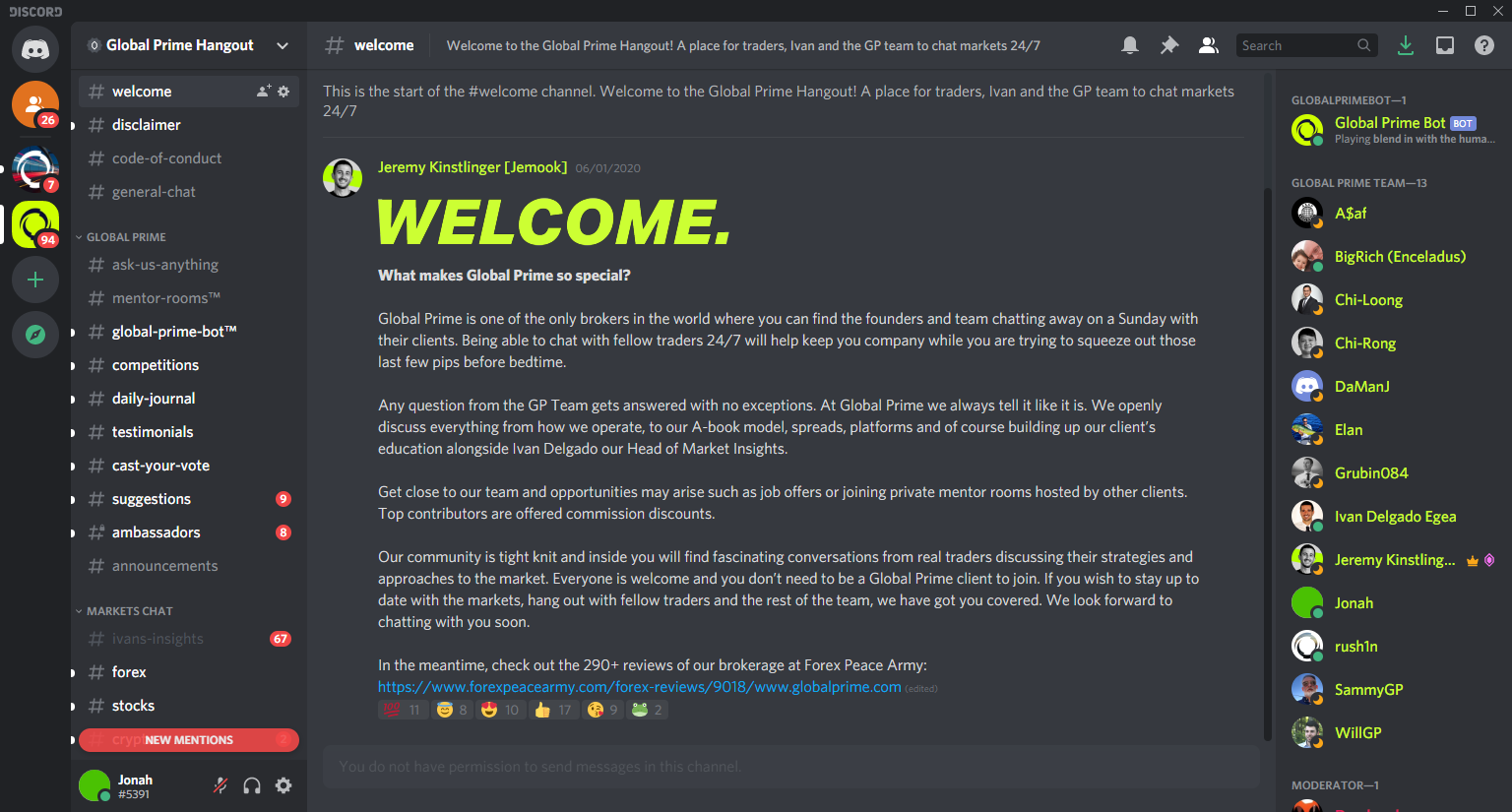
Global Prime runs a Discord chatroom for clients to interact not just with each other, but also the owners, management and support team.

Discord Chat Room

There are more than 4000 participants in the chatroom, and it’s a great place to go for a lively discussion. Many traders pay monthly subscriptions to join mature forex trading communities, which makes this feature a great selling point for serious traders. Additionally, this community of traders not only helps each other, but also holds Global Prime accountable to the high standards and expectations they set out for themselves.


Trading Academy

Recently, Global Prime began building out multiple, fully featured trading courses. From understanding why traders fail, choosing the right technical tools to understand market conditions, all the way to the importance of risk management; it’s all covered in their courses!

Global Prime Academy

Their courses are just the tip of the iceberg and serve as an entry point. They have also put together several integrated communities, bound in camaraderie as part of Discord rooms, where traders can communicate with each other and with their mentor, ask questions, analyze each other's trades, and so forth. Overall, this is a great example of how Global Prime wants their traders to be successful and it illustrates one of the major advantages of working with a broker that operates off of a commission model instead of profiting from their client's losses.


Great Reputation

The way Global Prime operates is widely endorsed by forex traders, thus validating their fresh take on running a forex broker.

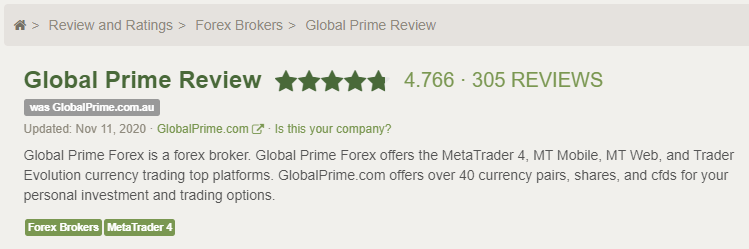
FPA Reviews

According to Forex Peace Army, Global Prime has an impeccable track record with over 300 detailed, highly positive reviews. This makes Global Prime one of the most highly rated brokers, especially when taking into account the high amount of reviews from actual retail traders.


Why it is Important to Trade with a Broker Like Global Prime

There is a large disparity between retail and institutional forex trading services. Logically, any benefit that a broker offers, be it a bonus, a rebate, a lucrative competition or a gift, it will all be factored into the cost of every trade they facilitate. Most brokers make money from their clients' losses, much like a casino; this is how they can afford such lucrative sponsorships and incentives for clients.

If you want a competition, consider playing poker or maybe even the lottery. If you aspire to be successful at trading forex, follow me and choose a broker with a transparent pricing model, the tightest possible spreads, with stable technology, who maintains reliable services and supports you as a trader. Bottom line; using Global Prime as my forex broker doesn't guarantee that I will be successful, but it puts me in the best possible position to succeed - it is entirely up to me and my skills as a trader whether I am profitable trading the markets.


Drawbacks and Other Tools

One of the few drawbacks of Global Prime as a broker is that they only offer MetaTrader 4 and Trader Evolution for trading platforms. I use MT4, which is perfectly fine for everyday trading, but is lacking certain features that other platforms offer these days. Trader Evolution looks interesting and appears to be on a promising trajectory for the future, but is still in fairly early development.

To compensate for this situation, I am using TradingView, mostly for charting purposes. TradingView offers a very good (and highly popular) web-based charting platform, not just for forex but for all major financial markets. I have come to appreciate how it allows me to navigate the markets and currency charts without having to do that in my trading platform MT4, that I almost exclusively use just to execute trades. This creates a natural separation between doing my research and actually putting money on the line.


Disclaimer

There are substantial risks associated with trading and investing in securities or other financial instruments. Trading and investing in stocks, bonds, exchange traded funds, mutual funds, money market funds, and cryptocurrencies involves risk of loss. Loss of principal is possible. Some high risk investments or trading certain financial instruments may use leverage, which will accentuate gains & losses. Trading in foreign exchange ('Forex') on margin, as well as trading cryptocurrencies, entails particularly high risk and is not suitable for all people. Before you decide to trade or invest in foreign exchange, or any other financial market, you should carefully assess your objectives, experience, financial possibilities and willingness to take risks. Past performance is not an indication of future results!

Lastly, please note that the links to Global Prime and TradingView on this page are affiliate links. If you use them to register an account, I may earn a small commission, you may get a discount or other benefits, and I will be identified as your introducing broker. This helps support the companies and both of us. I only endorse these companies because of the positive experience I've personally had using their products and services.

Share: